SUGAR, SALT AND WATER FOR DIARRHOEA
Most people with diarrhoea can be safely treated at home.
What is diarrhoea?
When you have diarrhoea your stools are not normal. Your stools are different because they:
- have more water
- come more often
- usually, they smell different.
When you have diarrhoea your body loses salt and water. This loss of salt and water makes you ill.
Taking salt and water
- Eating salt and drinking water will not help.
- Because of the diarrhoea your body cannot take and use this salt.
Sugar
- Sugar can help. Taking sugar and salt with water together helps your body use the salt.
- How much sugar and how much salt is important
- You must use the correct amount.
|
Sugar and Salt Measures - The Special Spoon
Order the spoondirectly from Health Books International 
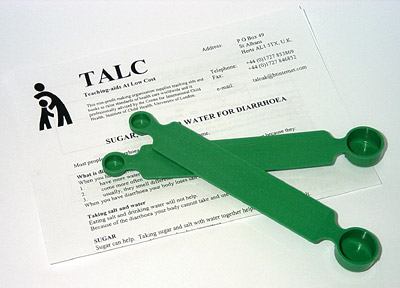
A spoon to measure sugar and salt accurately in order to treat diarrhoea which causes the body to lose salt and water. Salt can not be replaced by eating on its own, but using the spoon to put both measures of salt and sugar and in a glass of water helps your body absorb the salt and provide rehydration. Available with instructions on the spoon in English, Chinese, and Portuguese. Discounts available for large orders (please contact Health Books International). Please note this product is for use in developing countries only. |
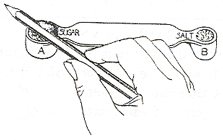
This is a picture of the spoon, it has two ends. The spoon is for measuring sugar and-salt. The large end (A) is for sugar. The small end (B) is for salt. Spoons also available in Arabic, Chinese, Portuguese and Spanish. Some experts believe that more sugar should be used, so you may use two scoops of sugar (fill the large end twice) if you wish.
Using the spoon
- Fill the small end (B) with salt.
- Make the salt flat. Use a pencil, a knife or anything straight
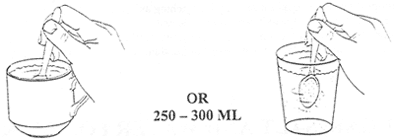
- Put salt into a cup or glass of water
- Fill the large end (A) of the spoon with sugar.
Make the sugar flat.
Put the sugar into the glass of water with the salt.
Mix the water, sugar and salt. Mix until you cannot see the sugar and salt.
Taste before drinking. If it is very salty throw it away and start making the drink again.
It should not be more salty than tears.
|
IMPORTANT
Too much salt is dangerous. Use only small spoon of salt
in one glass of water.
A little extra sugar doesn't matter. |
Drinking the salt, sugar and water.
- Drink the salt, sugar and water slowly.
- Take about 10 minutes to drink it.
-
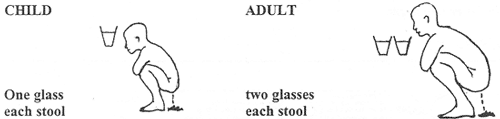
Men and women must drink 2 glasses after every stool. Children must drink 1 glass after every diarrhoea stool.
|
Stool and Vomit Volume
|
Vomiting
After drinking, the child or adult may vomit the sugar, salt and water. Do not worry. Continue giving the drink. Give a little more to replace what has been vomited, and give it more slowly. Encourage the child to drink a diluted cereal as well as the sugar and salt mixture. Eating or drinking a cereal food (such as rice or maize) may reduce stool volume by half.
Get help when the person with diarrhoea:
- is a very small baby;
- has green in their vomit;
- becomes more ill;
- does not answer clearly when spoken to.
Continue using the salt, sugar and water until help comes.
|
Important
When the child with diarrhoea is bottled-fed (formula fed) and
not old enough to take food SEEK HELP.
Until help comes alternate between a glass of plain water and
a glass of sugar and salt mixture after every stool. |
|