|
| |
Facts About Children, Diarrhoea, Water, Women, Hunger ...
ORT now helps save more than 1 million children's lives each year.
Oral Rehydration Therapy (ORT) a simple, cost-effective treatment given at home using either packets of Oral
Rehydration Salts (ORS), costing about 10 cents each or a simple home solution of sugar, salt and water can prevent about 90% of child
deaths from diarrhoeal dehydration.
Dehydration caused by diarrhoea is the biggest single killer of children
in the modern world and diarrhoea itself is one of the major causes of nutritional loss and poor growth.
UNICEF and its partners have helped more than 45 countries to achieve treating 80% of child diarrhoea cases with ORT.
The infant mortality rate fell about 3% a year from 1950 to 1991. Prime reasons, according to the National Center for Health
Statistics: fewer deaths from pneumonia and influenza, respiratory distress syndrome, prematurity and low birthweight, birth defects and accidents.
61 nations are set to double their populations in one generation, between 1990 and 2025. |
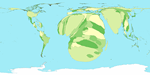 |
Cartograms - Images of the Social and Economic World
On a regular map, the sizes of the countries of the world are in proportion to their actual sizes on the surface of the planet and their
shapes are the same as their actual shapes. Here are redrawn maps with the sizes of countries made bigger or smaller in order to represent something
of interest. Such maps are called cartograms and can be an effective and natural way of portraying geographic or social data. Here are some
examples of Population, Gross domestic product, Child mortality, People living with HIV/AIDS, Total spending on healthcare, Energy consumption
(including oil), and Greenhouse gas emissions. |
|
Millennium Development Goals
| Facts. You decide. |
|
| The Millennium Development Goals (MDGs) are eight goals to be achieved by 2015 that respond to the world's main development challenges. The MDGs are drawn from the actions and targets contained in the Millennium Declaration that was adopted by 189 nations during the UN Millennium Summit in September 2000. The facts below help provide a clearer picture of the world's progress towards achieving the eight MDGs. |
|
|
|
Goal 1 Eradicate extreme poverty and hunger |
|
| |
2 In developing countries, children from the poorest 20 per cent of households are more than 2 times as likely to be underweight as children from the richest 20 per cent. |
| |
|
|
| |
1.5 In developing countries, rural children are 1.5 times more likely to be stunted than urban children.
|
| |
|
|
| |
1 in 5 Worldwide, 1 in 5 workers and their families are living in extreme poverty. |
| |
|
|
| |
27 The percentage of the population in developing regions living on less than $1.25 a day is 27. |
| |
|
|
| |
43 million The number of people worldwide displaced because of conflict or persecution was nearly 43 million in 2010. |
| |
|
|
|
|
|
| |
| |
Goal 2 Achieve universal primary education |
|
| |
15 Half of the world’s out of school children live in 15 countries.
|
| |
|
|
| |
10 Ten countries account for 72 per cent of the total number of illiterate adults worldwide.
|
| |
|
|
| |
18 Sub-Saharan Africa had a gain of 18 percentage points in net enrollment rates for primary education between 1999 and 2009. |
| |
|
|
| |
89 The literacy rate of youth aged 15-24 increased to 89 per cent in 2009, up from 83 per cent in 1990. |
| |
|
|
| |
7 The percentage point increase in primary net enrolment in the developing world between 1999 and 2009 was 7. |
| |
|
|
|
|
|
| |
|
|
Goal 3 Promote gender equality and empower women |
|
| |
97 In 2009, 97 girls were enrolled in tertiary education for every 100 boys in the developing world. |
| |
|
|
| |
40 Worldwide, the share of women in non- agricultural paid employment increased to 40 per cent in 2009, up from 35 per cent in 1990. |
| |
|
|
| |
96 In developing regions, the number of girls enrolled in primary and secondary school was 96 for every 100 boys in 2009. |
| |
|
|
| |
19 Worldwide, the proportion of seats held by women in single or lower houses of national parliaments is 19 per cent. |
| |
|
|
| |
96 Gender parity in primary education is improving, with the gender parity index at 96 percent or higher in most developing regions. |
| |
|
|
|
|
|
| |
|
|
Goal 4 Reduce child mortality |
|
| |
35 Since 1990 the global under-five mortality rate has dropped 35 per cent—from 88 deaths per 1,000 live births in 1990 to 57 in 2010. |
| |
|
|
| |
2 In developing regions, children of mothers with no education are more than twice as likely to die before their fifth birthday as compared with children of mothers with secondary education or higher. |
| |
|
|
| |
2 In developing regions, children from the poorest 20 per cent of households have more than 2 times the risk of dying before their fifth birthday as do children from the richest 20 per cent of households. |
| |
|
|
| |
5 Both pneumococcal and rotavirus vaccines have been introduced at the national level in 5 percent of low-income countries, as compared to 42 percent of high-income countries. |
| |
|
|
| |
1 in 6 Approximately 1 in every 6 child deaths in Africa was due to malaria in 2008. |
| |
|
|
|
|
|
| |
|
|
Goal 5 Improve maternal health |
|
| |
34 Worldwide 34 per cent of maternal deaths are caused by haemorrhage. |
| |
|
|
| |
1 in 4 In Sub-Saharan Africa, the family planning needs of one in four women are not being met. |
| |
|
|
| |
22 In Sub-Saharan Africa, where maternal mortality is high, only 22 per cent of women aged 15 to 49 were using some form of contraception. |
| |
|
|
| |
1 in 10 In sub-Saharan Africa, 1 in 10 adolescent women use contraception. |
| |
|
|
| |
2.6 The percentage of total official development assistance to health spent on family planning was 2.6 in 2009. |
| |
|
|
|
|
|
| |
|
|
Goal 6 Combat HIV/AIDS, malaria and other diseases |
|
|
290 million Across Africa, 290 million long-lasting insecticide treated nets (LLINS) have been delivered since 2008. |
|
|
|
|
|
13.2 million Of the world’s 19.3 million children not immunized with DPT3, 13.2 million live in 10 countries. |
|
|
|
|
|
50 Between 2000 and 2009, there was a greater than 50 per cent reduction in malaria cases in the 21 malaria–endemic countries in the Americas. |
|
|
|
|
|
60 Worldwide over 60 per cent, or 3.23 million, of all young people living with HIV are young women. |
|
|
|
|
|
28 Across developing countries 28 per cent of young women aged 15-24 used a condom at last high risk sex, compared with 43 percent for young men. |
|
|
|
|
|
|
|
| |
|
|
Goal 7 Ensure environmental sustainability |
|
| |
751 Worldwide, 751 million people use shared sanitation facilities. |
| |
|
|
| |
15 The proportion of fish stocks estimated to be underexploited or moderately exploited declined from 40 per cent in the mid-1970s to 15 per cent in 2008. |
| |
|
|
| |
1.1 billion Worldwide 1.1 billion people still defecate in the open.
|
| |
|
|
| |
30 More than a quarter of the population in several Sub-Saharan African countries spends more than half an hour per round trip to collect water. |
| |
|
|
| |
828 million The number of urban slum dwellers globally was 828 million in 2010. |
| |
|
|
|
|
|
| |
|
|
Goal 8 Develop a global partnership for development |
|
| |
1/3 The least developed countries (LDCs) receive about a third of donors’ total aid flows.
|
| |
|
|
| |
4.4 By the end of 2010, fixed broadband penetration in the developing world averaged 4.4 per cent, compared to 24.6 per cent in developed regions. |
| |
|
|
| |
$128.7 billion Net aid disbursements from developed countries amounted to $128.7 billion in 2010 – the highest level of real aid ever recorded. |
| |
|
|
| |
3.6 The ratio of public debt service to exports for developing regions was 3.6 per cent in 2009. |
| |
|
|
| |
1,680 million The total official development assistance given to maternal, newborn
and child-specific health projects in 2006 rose to $1,680 million |
| |
|
|
|
|
|
|
|
|
70 million Over 70 million girls and women aged 15–49 years in Africa and in Yemen have undergone female genital mutilation/cutting. |
|
|
|
|
|
12 There are only 12 developing countries and territories with secondary school participation levels of 90 per cent or more. |
|
|
|
|
|
35 The prevalence of child marriage in the developing world is 35 per cent for women 20-24 years old, a decline from 48 per cent for women aged 45-49 years old. |
|
|
|
|
|
33 An estimated 33 per cent of pre-school age children do not get enough vitamin A in their diet. |
|
|
|
|
|
1 in 5 Nearly one in five child deaths worldwide is due to diarrhoea.
|
|
|
|
|
|
|
|
| |
|
updated: 23 August, 2019
|